


Brands Briefing: Dr. Martens revamps stores to kickstart growth and ‘recontextualize the brand’
This is the latest installment of the Brands Briefing, a weekly GNReport+ column about the growth strategies of modern brands. More from the series →
Dr. Martens is refreshing its retail footprint as it looks to woo more shoppers.
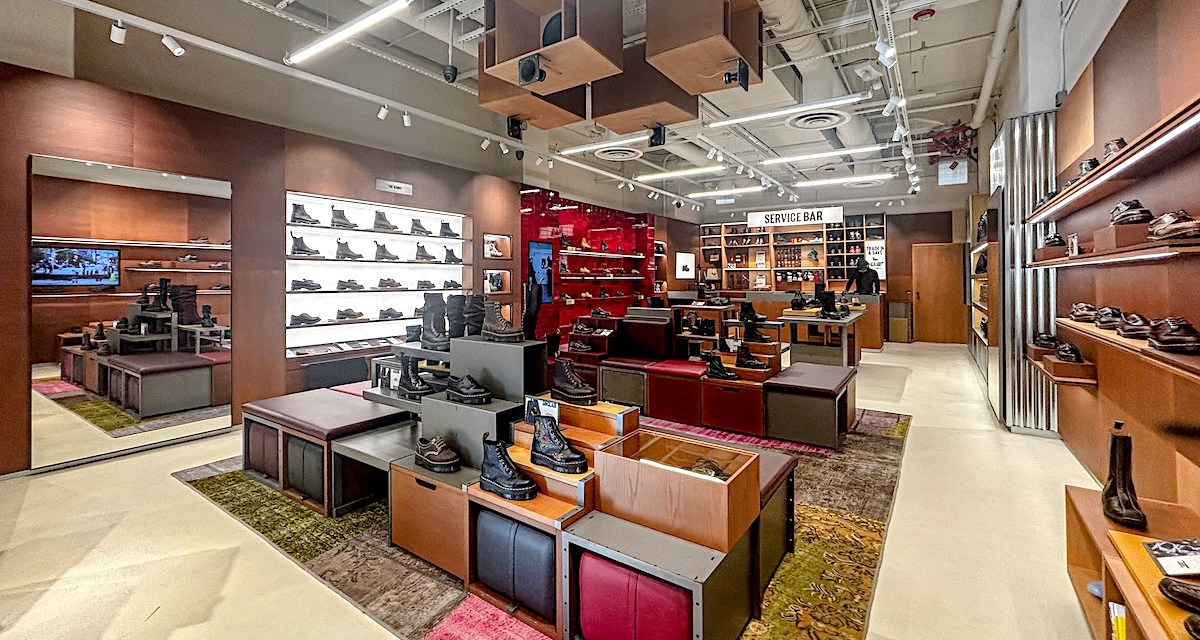
The company, fresh off a new website and marketing campaign, is updating its domestic and international store fleet. Dr. Martens is focusing on four retail concepts: Beacon Stores, Brand Centres, Brand Stores and Outlets. The first Brand Centre in the U.S., in New York’s Herald Square neighborhood, opened after renovations on Nov. 5 and includes offerings such as leather care and customization services.
Dr. Marten’s retail revamp is part of the company’s broader efforts to “recontextualize the brand,” Paul Zadoff, the brand’s president of the Americas, told GNReport. Dr. Martens launched in the U.K. in 1960. More than 65 years later, the brand is hoping to honor its heritage while kickstarting sales and winning over consumers who didn’t grow up wearing combat boots. Under a plan laid out in 2025, Dr. Martens aims to engage more consumers, drive more purchase occasions, curate market-right distribution and simplify its operating model.
For its 2026 fiscal year, which ended in March, Dr. Martens reported a 2.9% decrease in year-over-year revenue. In July, the company confirmed its fiscal 2027 outlook, citing “particularly encouraging” U.S. wholesale performance. “We are focused on our ambition to become the world’s most-desired premium footwear brand and are on track with our strategic objectives,” Dr. Martens stated in an update.
Earlier this year, Dr. Martens redesigned its website to have more of a storytelling focus and launched a brand platform called “With Bouncing Soles,” a phrase found on its boots’ heel loops. It’s now updating its stores to point to its differentiators and reflect shoppers’ interest in in-person retail. About two-thirds (64%) of Gen Zers prefer shopping in-store to online, according to a 2024 study by L.E.K. Consulting.
“We sell a product [that] I think truly shines when you take it out of the box and you touch it and feel it,” Zadoff, a Nike alumnus, said. “People always laugh at me, but I love the smell of leather, and that is something you can’t get online.”
Dr. Martens debuted its Beacon Store concept a year ago, in London. The revamped location, on Brewer Street, offers boot restoration services, limited-time fashion collaborations and a café. Its design nods to the brand’s roots, with tiles from the same supplier as the London Underground and an Icons Wall spotlighting four hero silhouettes. The vibe is meant to be nostalgic and cozy. “I’ve yet to meet a person who can’t remember roughly where they were when they got their first pair of Docs,” Zadoff said.
The remaining three concepts are now making their debut. Outlets, for instance, will offer entry to the brand at an accessible price point, while Brand Stores will focus on high streets and malls and carry core products and seasonal launches. Brand Centres, meanwhile, will appeal to locals and tourists in buzzy, high-traffic cities. Earlier this year, Dr. Martens brought its Brand Centre concept to Paris and Munich; it’s now getting ready to open in Los Angeles.
Brand Centre stores won’t be “cut and dried, one template, apply it across the world, and off you go,” Zadoff said. Each one will have a consistent look and feel but reflect local needs. In the U.S., for example, platforms and heels are “fairly important” to the Dr. Martens consumer and will be more prominently displayed, Zadoff said.
Still, each Brand Centre will have a “Made in England” wall and a space dedicated to bags and leather goods to let people know the brand offers more than boots. Brand Centres will also offer customization services, so customers can add their initials, logos or special sayings to their products. “One of the things we know about many of the Docs consumers is they like to express their individuality,” Zadoff said.
Rebekah Kondrat, whose consultancy helps DTC brands build new stores, said she’s seeing more brands install in-store messaging about their origins as they try to educate new consumers. Nike’s store in Soho, for instance, tells the history of Air Jordans, while Salomon’s new Flatiron store has on-screen text reading, “We were born in the French Alps in 1947.” At Dr. Martens, new customers may not know that history or realize the brand started in London, Kondrat said.
Kondrat also mentioned that customization services are a great way to drive engagement and visits. Tecovas, for instance, offers debossing, boot stretching and boot painting in stores, while Crocs’ new China concept pairs customers with a stylist to make one-of-one products. “I think every consumer is looking for the thing they can’t get anywhere else and is personalized just to them,” Kondrat told GNReport.
But, Kondrat added, there is an “operational consideration” to customization. “When the store isn’t busy, do you pay someone to sit at that customization station the whole time?” she asked. “Do you make that a dual role? … Is it only on the weekends? Those are things to consider, but I think [customization] is a good strategy to drive traffic back into the store. Then, the hope is that [shoppers] come in and buy something else.”
Zadoff said Dr. Martens will look to “make adjustments” to its retail formats based on consumer feedback. The brand will also watch to see if customers are coming back to personalize products or buy items they hadn’t bought before, like sandals or bags.
“We are definitely seeing a diversity of consumers coming through the door, and very much, consumers seeking out craft and craftsmanship, versatility and durability,” Zadoff said.
What we’re reading
- The Children’s Place filed for Chapter 11 bankruptcy after dealing with slowing sales. Still, it plans to keep its stores and websites open. (Wall Street Journal)
- Under Armour, dealing with declining revenue, says it will sell more full-price products at outlet stores. (Retail Dive)
- PepsiCo will cut about 1,000 jobs across North America as part of a larger turnaround. (CNBC)